Under-Sink Organization Around Pipes: A Measure-First Guide
As an Amazon Associate I earn from qualifying purchases. This article contains affiliate links.
An under-sink organizer can fit the cabinet and still collide with a drainpipe. The useful storage area is the space left around plumbing, shutoffs, hinges and the path needed to remove a bin. Measure that space before ordering a tiered rack.
Under-sink organization works best when supplies remain identifiable and leaks remain visible. A cabinet full of neatly packed boxes is less convenient if you have to unload everything to reach a valve or inspect a damp patch.
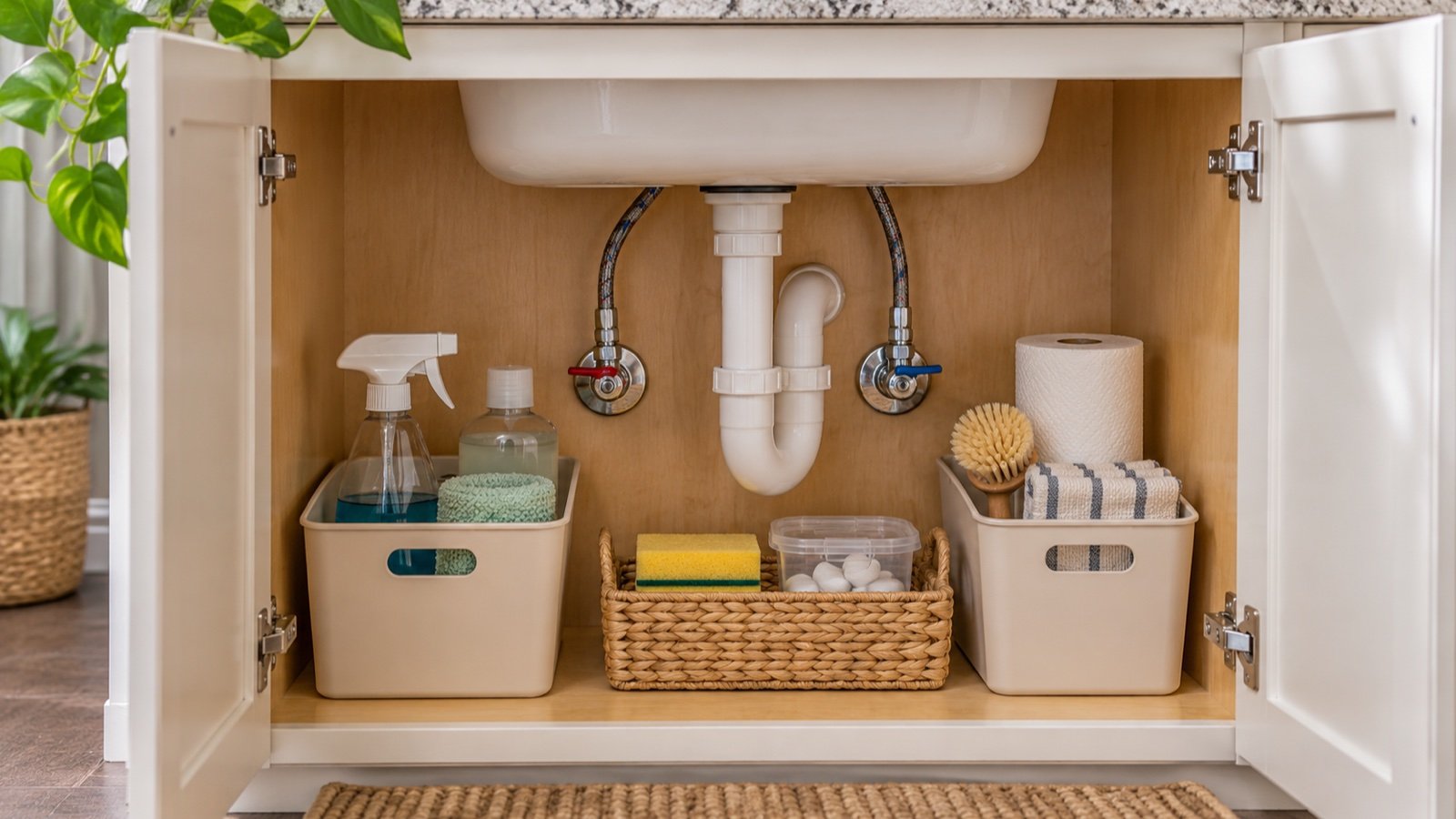
Featured image: AI-generated decorating inspiration, not a photograph of a tested makeover or a specific reviewed product.
Map the obstacles before the shelf
Draw the cabinet from the front and above. Mark the drain assembly, valves, hoses, hinges and any equipment installed inside. Check which parts need access for normal use or servicing. Do not move plumbing to suit an organizer. A basic sketch often shows that one tall side and one short side are more realistic than a symmetrical two-tier arrangement.
Measure the opening as well as the interior
The inside cabinet width may be greater than the door opening. Account for hinges and any central frame. Measure the route a loaded bin follows as you pull it out. An organizer can sit neatly inside while its handle catches on the doorway. Compare usable tray dimensions rather than relying only on the overall product size.
Choose low bins when pipes take the height
A few low removable containers can work around irregular plumbing better than a rigid rack. Give each a clear category and keep the contents suitable for the cabinet conditions. Leave enough room to lift one out without tipping another. Do not stack cleaning products so that labels disappear or bottles press against hoses.
Check a pull-out at full extension
A sliding unit needs a clear route in front and enough space for the loaded contents to pass the plumbing. Inspect the manufacturer's installation and load directions. Consider whether screws, adhesive or another fixing are required and whether the cabinet is suitable. A freestanding bin is a reasonable alternative when a more elaborate mechanism cannot be installed correctly.
Keep cleaning products in their original containers
Preserve labels, closures and storage instructions. Do not transfer chemicals into decorative jars or beverage-style bottles. Store them as directed and keep children from accessing them using suitable household precautions. Under the sink is not automatically the right place for every product; move items if their directions or your household circumstances require another location.
Leave the base inspectable
A suitable removable tray may help contain small drips, but it does not fix a leak. Avoid covering the entire base with layers that conceal moisture. Keep access to inspect and clean the cabinet. If you find dampness or plumbing problems, address the cause before organizing around it. Leave a simple removal route so storage does not delay maintenance.
Compare the options
| Option or situation | Useful starting point | Check before choosing |
|---|---|---|
| Low pipe clearance | Short removable bins | Lift-out space and clear product labels |
| One open tall side | Single suitable organizer | Complete height and load guidance |
| Doorway narrower than cabinet | Narrow separate bins | Handle and hinge clearance |
| Frequent maintenance access | Light movable storage | Valve access and visible cabinet base |
A worked planning example
Consider an illustrative cabinet opening 20 inches wide with a pipe descending through its middle. Two 10-inch bins will not necessarily pass together, and a two-tier rack may meet the pipe on its upper level. Sketch the actual obstacle instead of dividing the empty rectangle. A short bin on one side and a taller container on the other may use the space more sensibly. Verify the exact product's external and usable dimensions before buying; this example is not a plumbing design.
What to compare when shopping
The links below open Amazon searches for product categories, not verified exact-product recommendations. Check the specific listing, size, variant and manufacturer instructions before purchasing. No price, availability or physical testing is implied.
Low removable bins
Check handle width and lift-out access.
Compare low removable bins on Amazon Example pictured: NETANY gray plastic storage baskets, eight-pack. View pictured product on Amazon.
Split organizers
Compare the pipe opening and complete operating dimensions.
Compare split organizers on Amazon
Removable drip trays
Choose a suitable size that can be removed for inspection.
Compare removable drip trays on Amazon
For more ideas, explore small bathroom ideas and bathroom styling ideas.
Product options to compare
These specific product examples relate to the ideas above. Check dimensions, materials, installation instructions and current availability on Amazon. They have not been physically tested for this guide.
Frequently asked questions
What is the first measurement for an under-sink organizer?
Map pipes, shutoffs and the actual cabinet opening before measuring the remaining storage areas.
Is a pull-out organizer always better than a bin?
No. A pull-out needs installation and a clear extension path. A removable bin may be more useful in an irregular space.
Can a tray fix water under the sink?
No. A tray is storage protection, not a repair. Investigate and address the source of moisture.
Should I put cleaners into matching bottles?
Keep cleaning chemicals in their original labeled containers and follow their storage directions.