Small Pantry Organization Without Buying a Matching Bin Set
As an Amazon Associate I earn from qualifying purchases. This article contains affiliate links.
Small pantry organization goes wrong when the shopping starts before the sorting. A matching bin set can look appealing, yet the tall cereal box, backup cooking oil and everyday snacks may not fit its identical compartments.
Begin with your actual food and the way you cook. Some items work best in their original packages, some need a small basket and others simply need a clearer shelf position. The aim is to see what you have and put it back easily, without buying containers for every item.
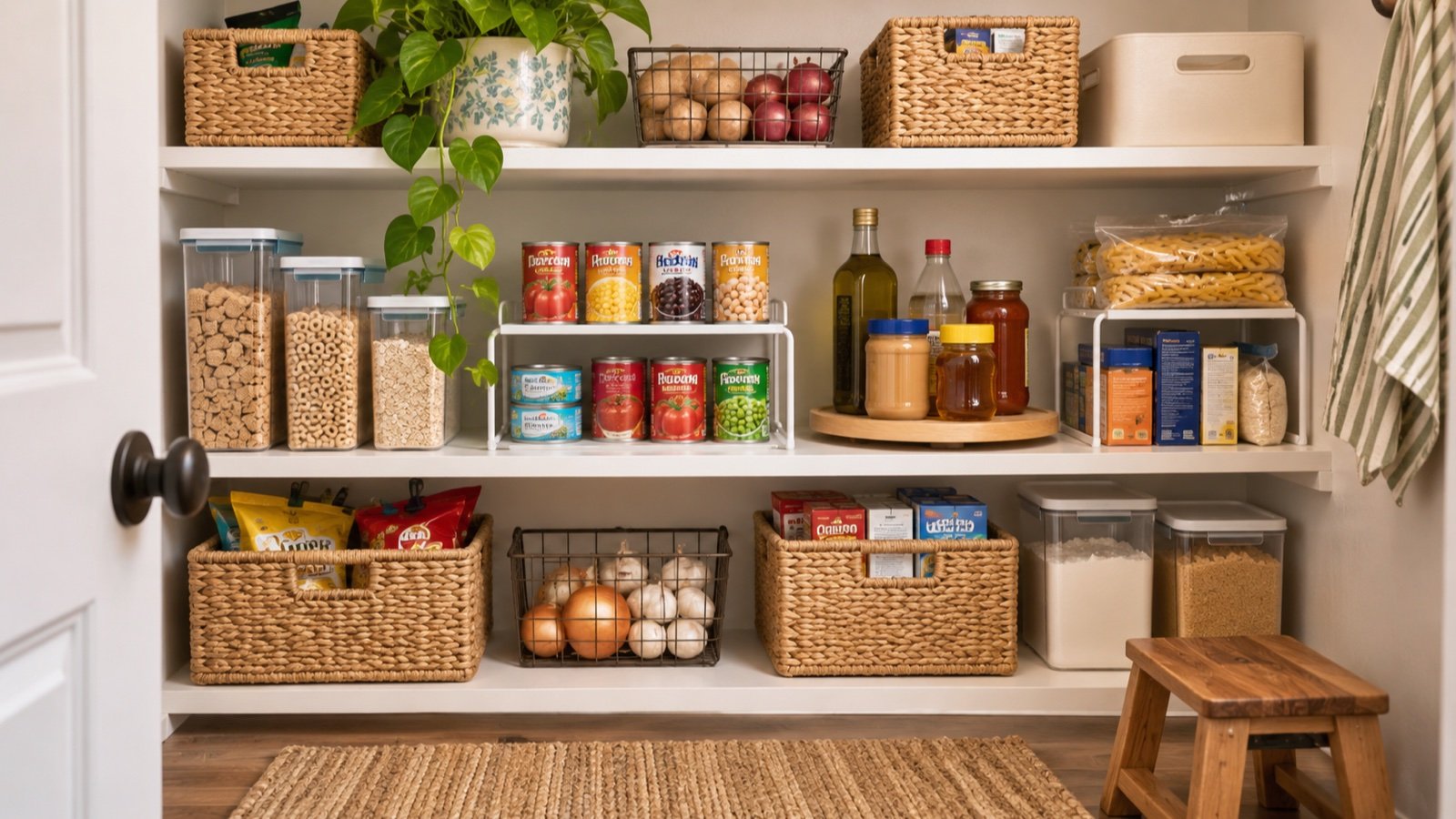
Featured image: AI-generated decorating inspiration, not a photograph of a tested makeover or a specific reviewed product.
Take an inventory one shelf at a time
Remove a manageable section and group what belongs together. Check package storage directions and dates as appropriate. Put food that needs a different storage environment in its proper place. Start with a shelf you can finish rather than leaving the whole pantry scattered through the kitchen. Note repeated duplicates; those may be a visibility problem rather than a need for another storage box.
Measure the space your hand needs
Record shelf depth, clear height and the opening through which a basket must pass. Include door hinges and shelf supports. A bin can fit on the shelf but still be awkward to lift out. Leave room to grasp its handle and inspect the contents. Shorter accessible groups often work better than deep containers you can only remove after shifting everything in front.
Organize by cooking tasks
Keep common meal ingredients in practical groups so you can gather what you need without searching several shelves. Your breakfast, baking or snack categories need not be the same size. Place everyday items at a comfortable reach and heavier supplies lower where appropriate. A pantry should reflect your household's use, not a universal arrangement copied from a photograph.
Use a riser for a visible second level
A suitable riser may help small jars or cans remain visible. Check how much height remains on both levels and whether containers can be taken out without tipping. Keep the arrangement stable. If packages are tall enough to hide the riser completely, a different shelf or a simple row may work better. Use the product's load directions rather than assuming any small shelf can support dense supplies.
Try a turntable where rotation is useful
A turntable can help access suitable bottles or jars in a difficult corner. Measure its full diameter, rim and clearance to rotate with the actual items on it. Keep tall or unstable objects from catching neighboring shelves. A round organizer also leaves unused space in square corners, so compare it with a basket before assuming rotation is always the more efficient option.
Decant selectively rather than automatically
If you transfer food, use suitable food-storage containers and preserve the information you need from the original packaging, including instructions, dates and allergen information. Consider whether the container holds a complete package before buying. Decanting can add maintenance without solving access. Keeping clearly identified original packages together in a simple basket may be the more convenient arrangement for your household.
Make a space for the next grocery trip
Leave some capacity for returning supplies instead of packing every shelf tightly. Put newly purchased items into the existing categories and review anything that no longer fits. A small overflow group can help if it stays visible and is checked. Avoid buying another bin every time the inventory changes; first decide whether the category or shopping routine needs adjustment.
Compare the options
| Option or situation | Useful starting point | Check before choosing |
|---|---|---|
| Short cans and jars | Stable shelf riser | Clear height on both levels |
| Suitable bottles in a corner | Turntable | Loaded diameter and smooth rotation |
| Mixed package shapes | Open basket | Lift-out access and visible contents |
| Food transferred from packaging | Suitable food container | Capacity, care and retained product information |
A worked planning example
For a worked example, a shelf opening 24 inches wide does not necessarily hold two bins each labeled 12 inches wide. Handles, hinges and the clearance needed to lift one out may prevent that arrangement. Measure the bins at their widest point and test the opening before ordering a pair. A single bin beside original packages may be more useful. These dimensions explain the method; they are not a recommendation for a specific product or pantry.
What to compare when shopping
The links below open Amazon searches for product categories, not verified exact-product recommendations. Check the specific listing, size, variant and manufacturer instructions before purchasing. No price, availability or physical testing is implied.
Shelf risers
Check usable width, height and rated load.
Compare shelf risers on Amazon
Pantry turntables
Measure loaded diameter and rim height.
Compare pantry turntables on Amazon
Food-storage containers
Verify intended food use, complete capacity and care instructions.
Compare food-storage containers on Amazon
For more ideas, explore small apartment ideas and more home organization ideas.
Frequently asked questions
Do I need matching containers to organize a pantry?
No. Original packaging, a few reused suitable baskets and clear categories can work well. Buy only for a specific access problem.
How should a very deep pantry shelf be organized?
Keep everyday items visible and choose storage you can remove comfortably. Avoid hidden categories behind several unrelated rows.
Are turntables always the best use of a pantry corner?
No. Compare loaded diameter and access with a rectangular basket or ordinary shelf arrangement.
What information should I keep when decanting food?
Retain relevant storage, preparation, date and allergen information from the original packaging and use suitable food-storage containers.