Cutting Board Storage: Upright Racks, Slots Or Cabinet Doors?
This post contains affiliate links. As an Amazon Associate, I earn from qualifying purchases at no extra cost to you.
Cutting board storage should make the board you use every day easy to remove and return. Stacking every board flat can bury the most useful one, while a narrow rack may not accommodate the thick board or handle in your collection. Start with thickness and access before choosing a new organizer.
Compare a stable upright rack, an existing suitable cabinet slot and a properly specified door organizer using your actual boards. Include handles, cabinet hinges and the loaded door swing. Clean and dry the boards according to their own care instructions before putting them into storage.
Featured image: AI generated decorating inspiration. It does not show a tested makeover or the exact products linked below.
Product Examples To Compare
Specific pictured items to compare after checking your own measurements and requirements.
These are product examples, not hands on test results or a ranked best products list. The picture and button for each example open the exact listed product. Check the current variant, dimensions, materials and instructions on Amazon before buying. Prices and availability can change.

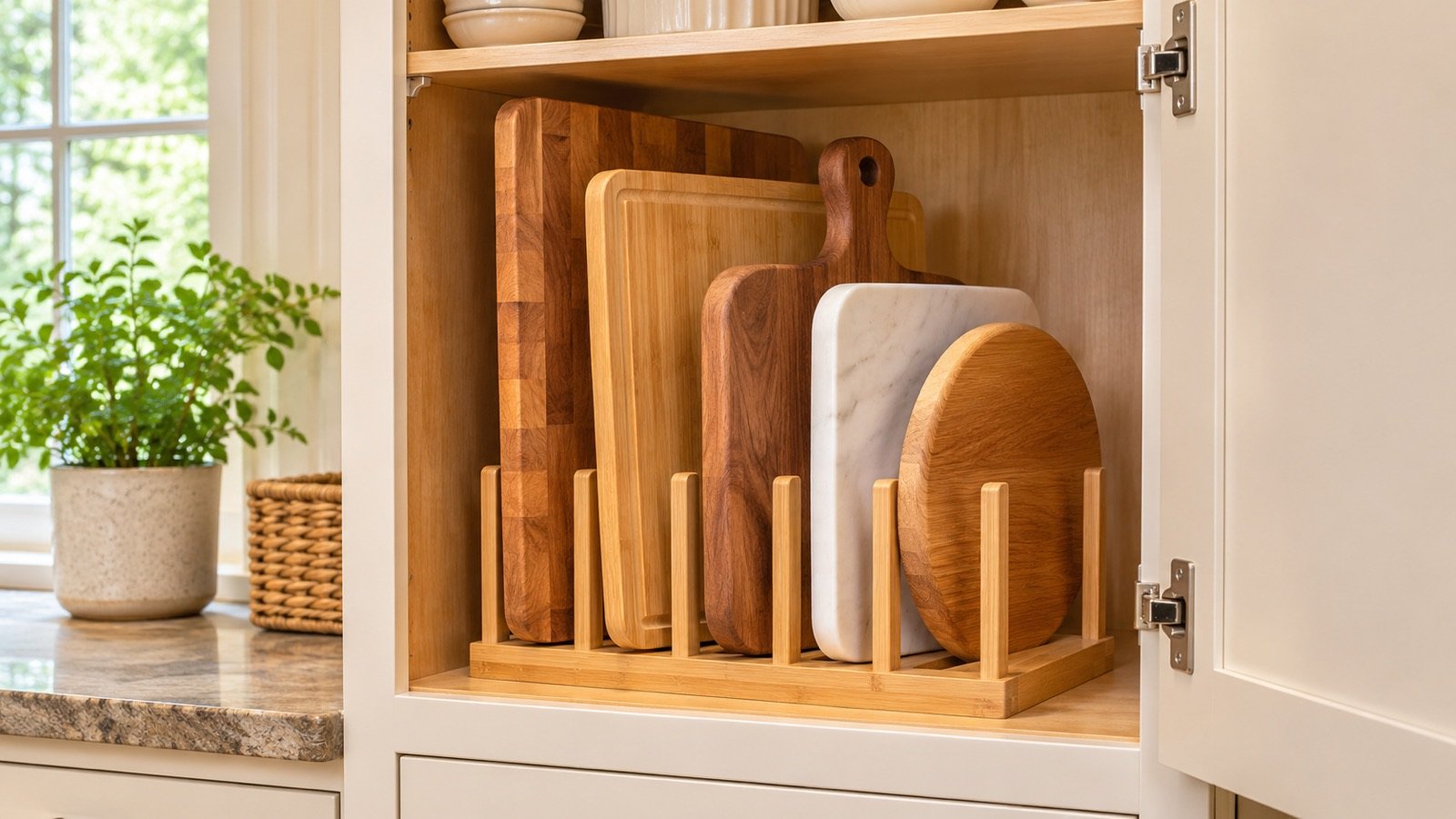
Example pictured: Kunovo Bamboo Dish Rack,Pot lid/Plate/Cutting Board Organizer for Kitchen cabinets,Bottle Drying Holder
Check rack slots, loaded stability and intended use. Follow the board care instructions and keep the storage arrangement appropriately dry.
Sort Boards By Use And Shape
The collection may need more than one storage position.
Set the boards out with their handles and feet visible. Identify the frequently used board and the unusually heavy or oversized one.
A thin flexible board and a thick wooden board do not necessarily belong in the same slot. Keep any manufacturer care information available. This is a storage comparison, not a recommendation to replace usable boards with a new material.
- Identify the daily board.
- Separate unusually thick or heavy pieces.
- Include handles and attached feet.
Check The Rack Slots With The Real Boards
An organizer's overall size does not tell you what each gap holds.
Compare slot width, base support and the way a board leans. A rack marketed for lids may or may not suit the board's shape and weight.
Read its intended use and limits. Check that the board does not project into the hinge or prevent the cabinet from closing. Leave enough space for a hand to lift it out without scraping a neighboring surface.
- Check individual slot dimensions.
- Read intended use and load limits.
- Allow room for removal.
For the related room plan, see our kitchen drawer organization.
Use An Existing Cabinet Gap If It Works
A dedicated product is not always necessary. If drinkware competes for the same cupboard, plan its footprint separately with these water bottle storage ideas.
A suitable existing vertical compartment may already separate boards from larger cookware. Check that the board stands or rests appropriately and is not pressed against an unsuitable surface.
Avoid creating a narrow wedged slot that makes a heavy board difficult to retrieve. Test the arrangement with nearby pots and trays in their normal positions, not removed for the demonstration.
- Try the current cabinet first.
- Keep heavy pieces easy to handle.
- Test with neighboring cookware present.
Treat A Door Organizer As A Moving Load
The door needs to function normally while loaded.
Check permission, attachment requirements and the cabinet manufacturer's guidance before installing anything on a door. The board and organizer must clear the shelves, hinge and adjacent contents throughout the swing.
A door rack can look efficient while making the door heavy or impossible to close. Choose another position if the complete arrangement cannot operate normally.
- Check the full loaded swing.
- Follow attachment instructions.
- Keep hinges and shelves clear.
Separate Drying From Long Term Storage
The storage rack does not replace the board's care routine.
Follow the board manufacturer's cleaning and drying directions. Do not put a damp board into a tightly enclosed or crowded location simply because it stands vertically.
Choose a routine that lets the item be put away in the condition specified for it. Storage advice cannot determine whether an unfamiliar board material is suitable for a dishwasher, soaking or a particular cleaning product.
- Follow the specific care label.
- Put boards away in the appropriate condition.
- Keep drying and storage jobs distinct.
Check How The Arrangement Works During Cooking
The useful board should not be behind the whole cookware collection. Keep frequently used seasonings reachable too; these spice rack ideas compare nearby storage without taking over the preparation area.
Take the board out while the counter and cabinet are in their ordinary cooking state. Notice whether another person or an open appliance door blocks the route.
Return it after the cleaning routine. If the rack shifts or catches adjacent items, reconsider its fit. The storage solution should reduce handling steps instead of adding a new obstacle near the preparation area.
- Test retrieval during a normal meal routine.
- Watch for movement in the organizer.
- Keep the return path simple.
Compare The Options
Use the same actual room and belongings to compare each approach.
| Situation | Option to Compare | Check First |
|---|---|---|
| Several suitable upright boards | A stable specified divider rack | Slot width and loaded stability |
| A useful existing compartment | Reuse the cabinet gap | Support and retrieval space |
| A possible door location | A properly specified door organizer | Attachment, hinges and full swing |
A Worked Planning Example
Illustrative measurements explain the method rather than establish a universal rule.
For an illustrative collection with a board 1 inch thick and another much thinner board, a rack with narrow fixed gaps may only fit one of them.
Measure each board and compare the intended supports. A wider suitable compartment for the thick board and a separate slim slot may be more practical than forcing both into one organizer.
Frequently Asked Questions
Answers to related questions found in the keyword research.
How Do You Store Cutting Boards?
Use a suitable clean dry location with support matched to the boards' actual shapes and weight. Compare upright and flat arrangements, then follow the board's care and storage instructions. For the wider context, see our kitchen drawer organization.
How Do You Store Cutting Boards On A Counter?
Choose an appropriate stable rack if counter storage suits your routine, and keep it out of the main work area. Check the board's care requirements and the rack's intended use. For the wider context, see our kitchen drawer organization.
Keep The Practical Choice
Choose the version that serves the way the household actually uses the room.
Choose the location that makes your everyday board easy to reach without compromising cabinet function. A simpler existing slot can be a better result than a crowded new rack.