Laundry Drying Racks: Wall-Mounted, Fold-Out or Freestanding?
As an Amazon Associate I earn from qualifying purchases. This article contains affiliate links.
A drying rack saves space only if it works when it is open and covered with laundry. The folded dimensions tell you where it can be stored; the working dimensions tell you whether the room remains usable.
Compare wall-mounted, fold-out and freestanding options by the clothes you dry, the location available and the installation you can support. A compact closed shape is not enough to choose a product for a busy laundry area or shared room.
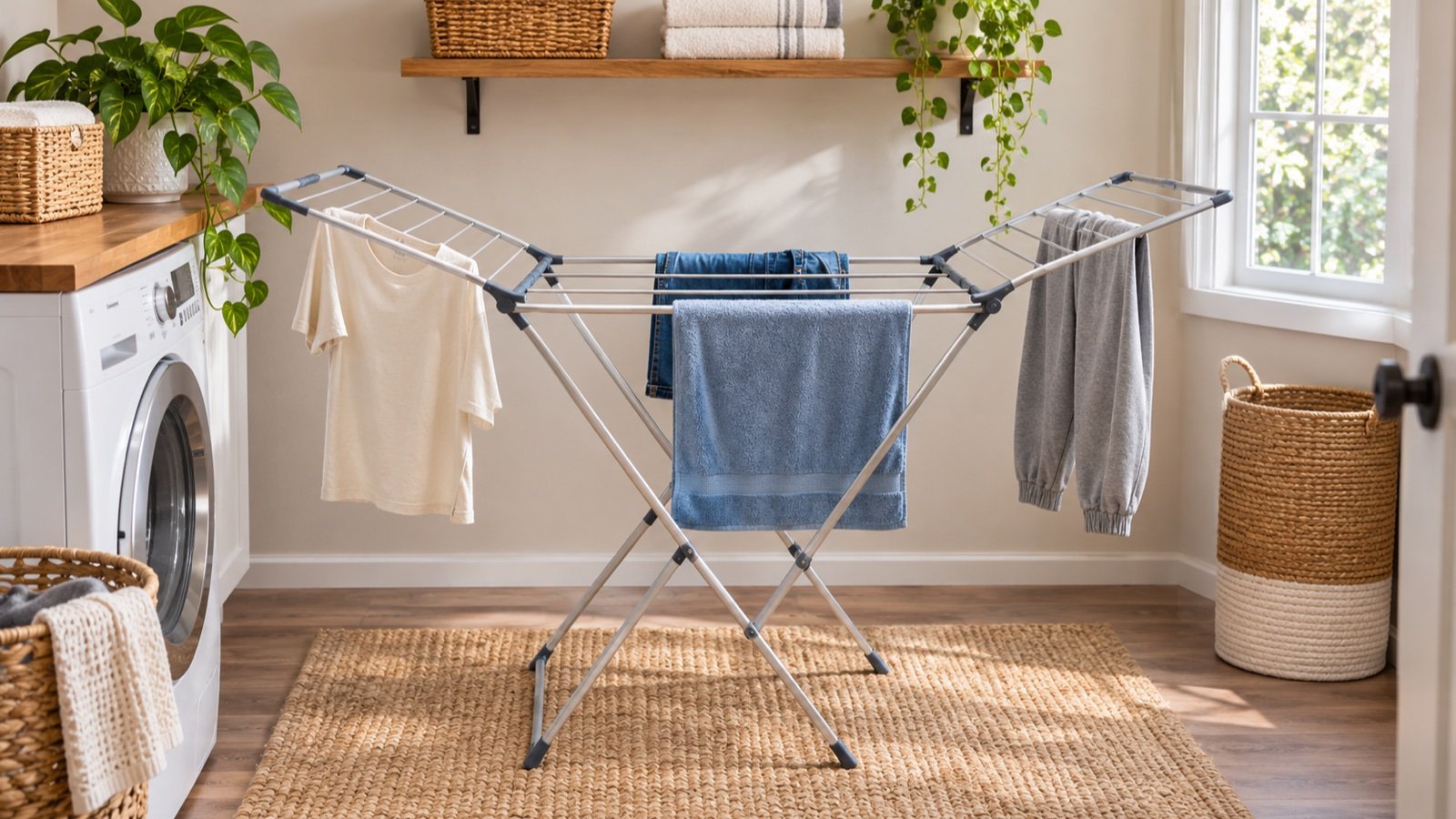
Featured image: AI-generated decorating inspiration, not a photograph of a tested makeover or a specific reviewed product.
Measure the loaded working area
Check the open rack dimensions and allow for the actual garments extending beyond its rails. Include the route around it and nearby doors. Do not count a folded rack's footprint as the space used during drying. Consider whether towels, shirts or longer garments will touch furniture, equipment or the floor in the intended position.
Choose freestanding for a flexible location
A suitable freestanding rack can move between locations and fold away afterward. Check stability, load guidance and the mechanism for opening and closing it. Find a practical storage place for it first. A rack that lives permanently half-open in a doorway is not functioning as flexible furniture, regardless of how slim it looks when folded.
Review wall mounting as an installation
A mounted rack transfers load to the wall and needs appropriate support. Follow the exact fixing and weight instructions and obtain any required permission. Check the projection when open and the space occupied by clothing. Keep it clear of equipment controls, required ventilation and routes. Do not treat any wall as suitable simply because it has an unused patch above a machine.
Compare folding arms and moving parts
Read how the rack locks or supports itself in the working position. Check whether you can operate it comfortably without reaching over another appliance. Consider the household and the product's guidance for moving parts. A mechanism should be used as intended, not forced to fit a narrow gap or overloaded because the frame appears sturdy.
Match rail layout to your laundry
Compare usable rail length, spacing and garment placement rather than a capacity slogan alone. Follow clothing care labels and the rack instructions. A layout that suits short lightweight items may be inconvenient for large towels. Keep garments arranged as appropriate for drying and do not assume that adding more layers increases useful capacity.
Choose a location with suitable conditions
Use a space with appropriate airflow and follow appliance and household requirements. Avoid blocking exits, windows that need to function or equipment vents. Keep the rack away from unsuitable heat sources and do not drape clothes over equipment to speed drying. Check the room during a normal load before deciding the setup works.
Compare the options
| Option or situation | Useful starting point | Check before choosing |
|---|---|---|
| Freestanding rack | Movable drying position | Loaded footprint, stability and storage |
| Wall-mounted rack | A permitted fixed location | Wall support, open projection and rated load |
| Fold-out arrangement | Occasional compact storage | Mechanism, working size and easy operation |
| Existing suitable rack | No replacement first | Better placement and laundry arrangement |
A worked planning example
Imagine a rack that is 24 inches deep when open, placed in a passage 48 inches wide. Garments may project farther than the rails, so simple subtraction may overstate the remaining route. Mark the loaded arrangement and use the door normally. If it obstructs movement, choose another location or a different system. This is a space-planning example, not a building-clearance recommendation or product performance test.
What to compare when shopping
The links below open Amazon searches for product categories, not verified exact-product recommendations. Check the specific listing, size, variant and manufacturer instructions before purchasing. No price, availability or physical testing is implied.
Freestanding racks
Compare working dimensions and intended loads.
Compare freestanding racks on Amazon
Wall-mounted racks
Review support, fixing and installation requirements.
Compare wall-mounted racks on Amazon
Laundry accessories
Select items suited to garment care and the actual routine.
Compare laundry accessories on Amazon
For more ideas, explore small apartment planning and clothing storage ideas.
Frequently asked questions
What size should I compare when buying a drying rack?
Compare both folded storage size and fully open loaded size, including garments extending beyond the frame.
Can a wall rack go above any washer or dryer?
No. Preserve appliance clearances, ventilation and controls, and verify suitable wall support and installation.
Is more advertised drying capacity always better?
Not if the arrangement crowds garments or the room. Compare usable rail layout with the laundry you normally handle.
Should I replace a rack that takes too much space?
First test another suitable location and arrangement. Replace it only if its working footprint or function remains unsuitable.